
How to structure a design team in a startup or scale-up: from 1 to 10 designers (2027)
Founding designer, design system, Head of Design, squads: the 5 stages to structure a design team from 1 to 10 designers, and the rituals that last.
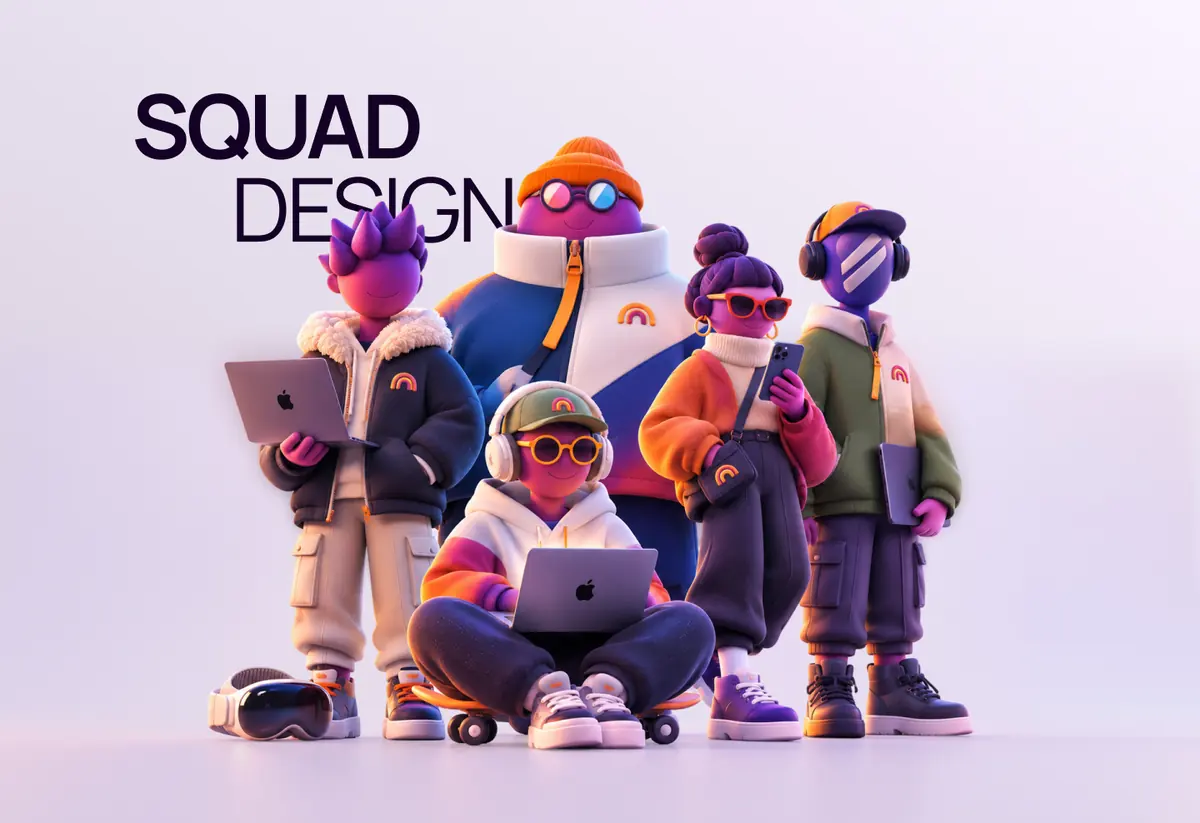
A startup design team is built in five stages: a founding designer who does everything, a second designer for the design system and the brand, a Head of Design who takes over approvals from the CEO, specialised profiles (design engineer, motion), then squads organised by product area. The order matters more than the headcount: hiring the right role at the wrong time costs more than waiting three months.
At Rainboow, we have been supporting startups and scale-ups in product design for over three years, after more than 15 years of freelance work for Octopia (Cdiscount), Weward, L'Addition and INSEP. At Weward, I was Lead Design and grew the team from 2 to 5 designers. This guide brings together what we have applied in the field, and what other French teams have shared publicly.
Article summary
- Early on, the value of a SaaS lies in its offer, not in its design: a UI kit and a UX-focused product designer are enough.
- The second designer spends about half of their time on the design system and the other half supporting the first one. The brand designer comes second or third, depending on needs.
- At around 4 to 5 designers, the CEO or the product lead can no longer approve everything: this is the time to hire a Head of Design.
- The design system becomes a full-time role, held by a profile halfway between designer and engineer, who bridges design, code and AI.
- Beyond that, the team is organised into product squads and cross-functional squads (design system, brand and motion).
- The rituals that last: a weekly design workshop of 2 to 4 hours, no status daily.
The 5 stages at a glance
Each stage answers a specific bottleneck. You only move to the next one when that bottleneck appears, not before.
- 1. Founding designer (1 designer): a UX-focused product designer. The CEO or the product lead approves the screens. Next signal: the designer becomes the PMs' bottleneck, the design system stops moving forward.
- 2. Structuring (2 to 3 designers): a product designer spending 50% on the design system, a brand designer depending on needs. The CEO or the product lead still approves. Next signal: the CEO spends their weeks approving screens.
- 3. Leadership (4 to 5 designers): a Head of Design. They approve the screens, the CEO sets the vision. Next signal: components drift from one feature to another.
- 4. Specialisation (5 to 7 designers): a design engineer (design system and AI), a motion designer. Next signal: several PMs compete for the same designers.
- 5. Squads (7 to 10 designers and more): lead product designers per area. The squad lead approves, the Head of Design arbitrates.
Stage 1: the founding designer (1 designer)
The first designer of a SaaS is a UX-focused product designer, not an art director. They join a product that the developers have already built with a UI kit, and what is missing is rarely the interface: it is the user flows.
Why UX before UI
In the first versions, the value of a SaaS lies in what it offers, not in how it looks. A UI kit handles the visual work very well. What developers do not cover are the flows: onboarding, empty states, errors, the sequence of screens.
What the founding designer does
- They rework the existing flows and fix what blocks activation.
- They design new features with the CEO or the product lead.
- They set the first visual rules, often without the time to build a real design system.
- They do a bit of everything: product screens, website, marketing visuals.
Who approves
At this stage, it is the CEO or the product lead, whichever of the two has a feel for design. This is normal and efficient: decisions are fast and the product vision sits in a single head.
The signal to move on
Product managers arrive and feed the designer with requests. They become the product team's bottleneck, and the design system they never had time to structure starts to get expensive: every new screen reinvents its components.
Stage 2: the design system and the brand (2 to 3 designers)
The second hire is there to relieve the founding designer and to start what they never had time to do: the design system. The brand designer comes second or third: there is no rule, it all depends on needs.
The second product designer: half design system, half support
They usually spend half of their time on the design system: structuring the components the founding designer created on the fly. The other half, they support the first designer, who has too much work, on ongoing features. This is not yet a 100% design system role: a dedicated profile will come later (stage 4).
The brand designer, with motion skills
Depending on the product, a brand designer arrives quickly to set or evolve the identity. Their scope goes beyond the product: website, communication, marketing, social media. If they can animate, they also cover motion until a specialist is needed.
The alternative is an external agency for the brand. It makes sense when the identity needs to be set once, less so when brand content production is continuous.
The signal to move on
The CEO, or the product lead, spends part of their week approving screens and directions. It was an asset with 1 designer. With 3 or 4, it has become a brake, for them as well as for the team.
Stage 3: the Head of Design (4 to 5 designers)
The Head of Design is hired when the CEO can no longer be the de facto creative director. In our experience, this moment comes at around 4 to 5 designers, which usually matches a company of about a hundred people.
What the Head of Design takes over
Until then, either the product lead or the CEO approves every screen, every direction, everything the designers propose. The Head of Design takes over this approval role, and brings three things nobody was doing:
- A direction: a shared design vision, instead of a sum of personal tastes.
- Momentum: processes, rituals, a skills ramp-up for the team.
- Management: hiring, reviews, careers, distribution of work.
Who approves what, before and after
- Product direction and priorities: before, the CEO and the product lead. After, the product lead and the Head of Design (the CEO keeps the vision).
- Design direction: before, the CEO. After, the Head of Design (the CEO approves the final result).
- Screen approval: before, the CEO or the product lead. After, the Head of Design.
- Designer hiring: before, the CEO. After, the Head of Design.
- Design processes and rituals: before, nobody. After, the Head of Design.
The Head of Design works mostly with the product lead. The CEO steps out of production: they set the vision and the overall direction, discover the proposals, let the team move forward, then approve when there is something concrete. Screens no longer go all the way up to them.
The signal to move on
Components drift from one feature to another, each designer recreates their own variants, and the product team starts prototyping with AI without a shared framework. The design system can no longer be a side project.
Stage 4: the design engineer and the motion designer (5 to 7 designers)
Once the Head of Design is in place, the two hires that make the team take off are a designer dedicated to the design system, with a real engineering profile, and a motion designer if the product or the brand requires it.
The design system becomes a full-time role
This designer does only that. And today, they need to be half engineer, what we call a design engineer. Their role is to bridge three worlds:
- The design system in Figma: tokens, components, variants, documentation.
- The code base: the same components on the code side, with the same names.
- AI tools: the rules and connections that allow the whole team to generate screens and MVPs that respect the design system.
AI was probably already used in the team before. The difference is that there is now a shared internal process, led with the Head of Design, instead of individual uses.
Good to know: an AI agent produces what it sees. With named tokens, documented components and written rules, it generates screens consistent with your product. Without a design system, each generation invents its own style.
The motion designer
If there is a real need for animation, a motion designer joins and works closely with the Head of Design and above all with the brand designer: illustration animation, brand sequences, product micro-interactions, marketing videos.
The signal to move on
Several product managers compete for the same designers. Priorities are negotiated case by case, and nobody really knows who is working on what.
Stage 5: designers per area, then squads (7 to 10 designers and more)
Beyond 7 designers, the team is organised by product area. First by assigning a product designer to each area, then by creating real squads with their lead designer.
First: a dedicated designer per area
Each product manager or product owner handles one area of the company: monetisation, the social side, onboarding… They have a dedicated product designer. When their area has less work, this designer helps on other projects. Regular syncs between designers prevent each area from reinventing its components.
Then: squads
The natural evolution is to organise into squads. There are two types:
- Cross-functional squads, serving everyone: the design system squad, and the brand and motion squad.
- Product squads, one per area. Each has a product manager and a lead product designer who manages its designers.
The Head of Design oversees the whole: they arbitrate between squads, own the processes and keep the product consistent.
The rituals that last as the team grows
The ritual that makes the biggest difference is a weekly design workshop of 2 to 4 hours. The one that makes the least is the 9am status daily. This is what we apply at Rainboow, as a 100% remote team.
The weekly design workshop (2 to 4 hours)
A fixed slot in the week, at least 2 hours, where the whole design team meets to make real progress, not to go round the table. On the agenda:
- Design system updates: what was created, updated or deprecated during the week.
- Team news: hires, arrivals, organisational changes.
- Unblocking workshops: a designer stuck on a feature? We form a mini-squad and spend an hour on it together.
- Design system / squads sync: one hour between the design system team and the designers concerned by a component. We decide together.
- Training and processes: a new tool, a new way of working, a lessons-learned session.
- Discovery sharing: 10 to 15 minutes, a different designer each week, on what struck them.
No status daily
In most of the startups and scale-ups we have supported, the 9am daily where everyone lists what they did is not effective. It turns into a discussion that cuts the morning in half. What works better:
- Scheduled PM / designer check-ins: once, twice or three times a week depending on the project pace, or on demand, always with a topic.
- An optional virtual coffee before the day starts: an informal moment just before 9am, open to everyone, with no agenda. Remotely, it replaces the coffee machine without eating into working time.
Benchmarks and what other French teams have done
The most quoted benchmark is one designer for five to six developers. In reality, many startups run well below that, and this is often where design becomes the bottleneck.
For Andy Budd, designer in residence at the Seedcamp fund, the accepted rule is one designer for five or six engineers, and many startups have 20 developers for 2 or 3 designers. His advice: prepare hiring and onboarding six months before a fundraise. (Seedcamp)
- Pennylane: at the end of 2021, 3 designers for 7 squads and around 100 employees. Six months later, 15 designers, including 2 design managers, 2 leads and 1 design system specialist. The team kept a knowledge-sharing session every two weeks and a Monday morning coffee.
- Doctolib: from 1 person in January 2018 to 22 in July 2020, across product designers, user researchers and brand designers.
The 4 mistakes to avoid
- Hiring a first "UI" designer to make the product look nicer. The UI kit already does that job. What is missing is almost always in the flows.
- Letting the founding designer be both designer and manager. The player-coach role quickly leads to burnout. They become a full-time manager, or you hire a Head of Design.
- Keeping the CEO as the approver of every screen. With 4 or 5 designers, every approval waiting for the CEO blocks the whole team.
- Replacing the workshop with dailies. Fifteen minutes of status every morning cost more than they bring.
Hire or outsource: at which stage
Hiring in-house is the right answer for the core of the product over the long run. Outsourcing is the right answer for a one-off need, a role you cannot yet justify full-time, or a hire that will take six months.
Hiring a senior designer usually takes 3 to 6 months, sometimes more, not counting the ramp-up. Meanwhile, the product keeps moving, with or without design.
Rainboow's Design Partner offer
This is the case covered by our Design Partner offer: senior product designers embedded in your product team, for much less than a hire or a full-time freelancer. It helps in three situations:
- You want to test before hiring: you are not sure about the need or the profile. We start within a week.
- You are taking the time to hire the right person: 3 months, 6 months or more. Production goes on, and we help you set up the design system and the processes your future hire will find on arrival.
- You have a workload peak: fundraise, launch, redesign.
Two plans, at €4,000 and €7,500 excl. VAT per month. For a one-off need, a project from €5,000 excl. VAT. See the Product Design offer
Jérémie's take: if you are not sure which profile to hire, start with an external team. You will see in real production what your product needs, and you will hire knowing exactly who to look for.
FAQ
When should you hire your first product designer?
When the product exists and the developers have built it with a UI kit, but activation or onboarding are stuck. The first designer must be UX-focused: the value of an early-stage SaaS lies in its offer, not in its interface.
How many designers for how many developers?
The usual benchmark is one designer for five to six developers, according to Andy Budd at Seedcamp. Below that, design quickly becomes the product team's bottleneck.
When should you hire a Head of Design?
When the CEO or the product lead can no longer approve every screen. In our experience, this moment comes at around 4 to 5 designers, usually a company of about a hundred people.
Do you need a designer dedicated to the design system?
Yes, from 5 to 7 designers. Before that, the second product designer spends about half of their time on it. Today this profile needs to be half engineer, to connect Figma, code and AI tools.
How do you organise a design team of 10 people?
In squads: product squads per area (one PM and one lead product designer each), cross-functional squads for the design system and the brand, and a Head of Design who oversees the whole.
Does the design team need a daily?
No, not a status daily. A weekly workshop of 2 to 4 hours, scheduled PM / designer check-ins and an optional virtual coffee work better, especially remotely.
Should you hire or work with an agency?
Hiring remains a good option to build a team over the long run. Rainboow's Design Partner offer brings the same thing, senior product designers embedded in your product team, for less than a hire. You delegate all design production, without managing holidays, absences or the constraints of an employee, and you start within a week.
Conclusion
A design team is not built by hiring as many designers as possible, but by adding the right role when a bottleneck appears: UX first, then the design system and the brand, then leadership, then specialists, then squads. And it lasts thanks to rituals that move things forward, not status meetings.
If you are between two stages, or if a hire is going to take six months, it is often the right time to talk about it. Shall we talk?
Sources


